
Best overall when a California state court permits a surety bond: a licensed bail agent. Best for spreading payments: an approved payment plan. Best for avoiding a commercial bond premium: court-ordered release without a commercial bond, if granted. For families comparing the best bail bond options for drug trafficking charges in 2026, Jake Hernandez Bail Bonds offers licensed, around-the-clock assistance across California.
- The best bail bond options for drug trafficking charges depend on the court’s release order, not the charge label alone.
- Jake Hernandez Bail Bonds serves California families seeking licensed bail bond assistance; court approval still controls release.
- A payment plan changes payment timing, not the total contractual responsibility.
- Federal drug cases require a separate release assessment under federal law.
Why this matters
A drug trafficking allegation does not tell you whether your loved one can leave custody on a commercial bond. You first need to know which court controls the case, whether bail is currently available, and whether another order prevents release.
Do not sign a bond agreement until you understand both the court’s release requirements and your financial obligations. A payment arrangement cannot remove a detention order or resolve a separate custody hold.
This 2026 guide compares release routes, not competing promises of faster release. The right choice starts with the actual court order.
What makes the best bail option?
Use these criteria before choosing an agent or committing money:
- Court eligibility: Confirm whether the court permits a commercial surety bond, cash bail, or another form of release.
- Financial responsibility: Separate the bail amount, the bond premium, installment obligations, and any collateral requirements.
- Co-signer exposure: Understand what you promise if you sign for someone else. Read the indemnity agreement, which explains your repayment responsibilities.
- Custody barriers: Identify other holds, warrants, or orders that require separate attention.
- Direct licensed assistance: Ask to speak with the licensed agent responsible for explaining and arranging the bond.
- Written terms: Get the payment schedule, collateral conditions, and contractual responsibilities before signing.
A useful first call establishes facts rather than collecting a payment immediately. Have these 4 details ready: the person’s full legal name, date of birth, booking number if available, and current jail location.
Bail options at a glance
The ranking below follows practical decision order. It is not a claim that every option is available in every drug case.
| Option | Best for | Standout feature | Key limitation |
|---|---|---|---|
| Licensed California surety bond | State cases with a bondable release order | A licensed agent arranges the commercial bond | Requires agent approval and does not override custody restrictions |
| Approved bond payment plan | Families needing scheduled payments | Spreads contractual payments over time | Approval and terms vary; the obligation remains |
| Cash bail | Families able to deposit the court-required funds | Avoids purchasing a commercial surety bond | Commits funds and remains subject to court rules |
| Attorney-led release request | Cases needing a change to release conditions | Asks the court to reconsider the release terms | Requires a judicial decision, not an agent’s approval |
| Federal court release process | Federal trafficking prosecutions | Addresses the federal court’s detention and release framework | A state bail arrangement does not substitute for federal authorization |
1. Licensed surety bond: best for bondable California state cases
A commercial surety bond is an undertaking to the court arranged through a licensed bail agent. The agreement creates financial responsibilities separate from the defendant’s criminal case.
Jake Hernandez Bail Bonds is best for California families seeking licensed bail bond assistance when a state court permits a surety bond. The business provides service across all 58 California counties. That service area does not mean every defendant qualifies for release.
Licensed surety bond pros:
- Provides an agent-led route when the court accepts a commercial bond.
- Gives you a written agreement defining the transaction.
- Lets you ask a licensed professional about the bond process and required paperwork.
Licensed surety bond cons:
- The premium is a contractual charge, not a refundable cash deposit with the court.
- Co-signers can take on substantial obligations under the agreement.
- A bond cannot override a detention order or separate hold.
Best for: A California state case with an established, currently usable surety-bond option.
Before signing, ask the agent to confirm the jail, booking record, and current release conditions. Ask who will explain the agreement and handle follow-up questions. A criminal defense attorney, not the bail agent, should advise you about defending the charge or challenging detention.
Verdict: Buy only after the agent confirms bond eligibility and you understand the written obligations.
2. Approved payment plan: best for scheduled bond payments
A payment plan is a way to pay for a commercial bond. It is not a different court order, a reduction in the bail amount, or permission to ignore the remaining balance.
Jake Hernandez Bail Bonds offers flexible payment plans. Approval and the actual agreement determine the terms available to your family; do not assume an advertised arrangement applies automatically.
Payment plan pros:
- Creates a schedule for paying the contractual balance.
- Lets you compare the required payments with your household budget.
- Provides a written structure for discussing co-signer responsibilities.
Payment plan cons:
- Approval is not automatic.
- Missed payments can create contractual consequences.
- Installments do not eliminate collateral or other requirements stated in the agreement.
Best for: A family that qualifies for a commercial bond but needs scheduled payments.
Separate these 3 amounts on your paperwork: the court’s bail amount, the bond premium, and the initial payment. They serve different purposes. A smaller initial payment does not mean the remaining premium disappears.
For a 2026 payment-plan comparison, request the total obligation and payment dates in writing. Also ask what happens if the case ends before the installments do. Do not assume the criminal case’s outcome cancels the payment agreement.
Verdict: Buy only if the entire schedule fits your budget and every signer understands the remaining obligation.
3. Cash bail: best for families able to commit the required funds
Cash bail means depositing the amount required by the court through the authorized process. It avoids buying a commercial surety bond, but it ties up funds that your household might need elsewhere.
Ask the court or jail which payment methods it accepts and who should appear as the depositor. Follow the instructions for the specific case rather than another county’s procedure.
Cash bail pros:
- Avoids a commercial bond premium.
- Does not require purchasing a surety bond from an agent.
- Creates a court deposit governed by the applicable release and deposit rules.
Cash bail cons:
- Requires access to the amount the court directs you to deposit.
- Funds are not available for ordinary household use while held.
- Return, forfeiture, and any authorized deductions depend on applicable rules and case events.
Best for: A family with sufficient accessible funds that understands the court’s deposit requirements.
Ask how the deposit is recorded, what paperwork you receive, and how a return is handled. Do not describe cash bail as risk-free. A failure to comply with court requirements can put deposited funds at risk.
Cash bail also does not bypass a separate hold or an unresolved court restriction. Confirm eligibility before arranging a transfer or obtaining payment instruments.
Verdict: Hold until you confirm the deposit instructions and can afford to have the funds committed.
4. Attorney-led release request: best for disputed release conditions
A defense attorney can assess whether to request a change to bail or other release conditions. The court decides the request. A bail agent cannot promise that the judge will reduce bail or authorize release.
Release on your own recognizance means release based on a promise to appear, subject to the court’s conditions, without posting a financial bond. It is an option to discuss with counsel, not an entitlement created by this guide.
Attorney-led release request pros:
- Addresses whether the existing release conditions should change.
- Allows legal arguments tied to the defendant’s circumstances and governing law.
- Can address alternatives to a commercial bond where legally available.
Attorney-led release request cons:
- Requires a court decision.
- Does not guarantee release or a particular hearing outcome.
- The court can impose conditions that the defendant must follow.
Best for: A case where bail is unavailable, disputed, or beyond the family’s means, or where counsel identifies grounds for reconsideration.
In 2026, ask defense counsel to explain the current order before purchasing a bond. The useful question is specific: does the existing order permit posting now, or does the court first need to act?
Verdict: Wait for legal guidance when the release order itself is the obstacle.
5. Federal release process: best for federal trafficking charges
Federal criminal release follows a different framework from California state bail. Under 18 U.S.C. § 3142, federal courts assess release conditions and detention; certain qualifying drug offenses trigger a rebuttable presumption concerning detention.
A rebuttable presumption is a legal starting point that can be challenged with evidence. It is not a statement that every federal drug defendant must remain detained.
Federal release process pros:
- Addresses the court that actually controls federal custody.
- Lets defense counsel respond to detention arguments and proposed conditions.
- Identifies any court-required bond or security within the federal proceeding.
Federal release process cons:
- A state commercial bond does not replace the federal court’s release decision.
- Detention proceedings involve legal standards that require case-specific advice.
- Court authorization does not resolve an unrelated custody barrier automatically.
Best for: A defendant facing federal rather than California state prosecution.
Ask federal defense counsel what the release order permits before contacting anyone about posting security. Do not rely on a state bail quote to explain a federal case.
Verdict: Skip a state-bond purchase unless counsel confirms it addresses the actual custody requirement.
Check the release barriers before signing
Drug cases require particular care with questions about the source of bail funds. California Penal Code § 1275.1 addresses circumstances in which release is withheld while the court considers whether bail funds were feloniously obtained.
That does not mean every drug trafficking arrest has a source-of-funds restriction. Ask whether such an order exists in this specific case, and have defense counsel explain what the court requires.
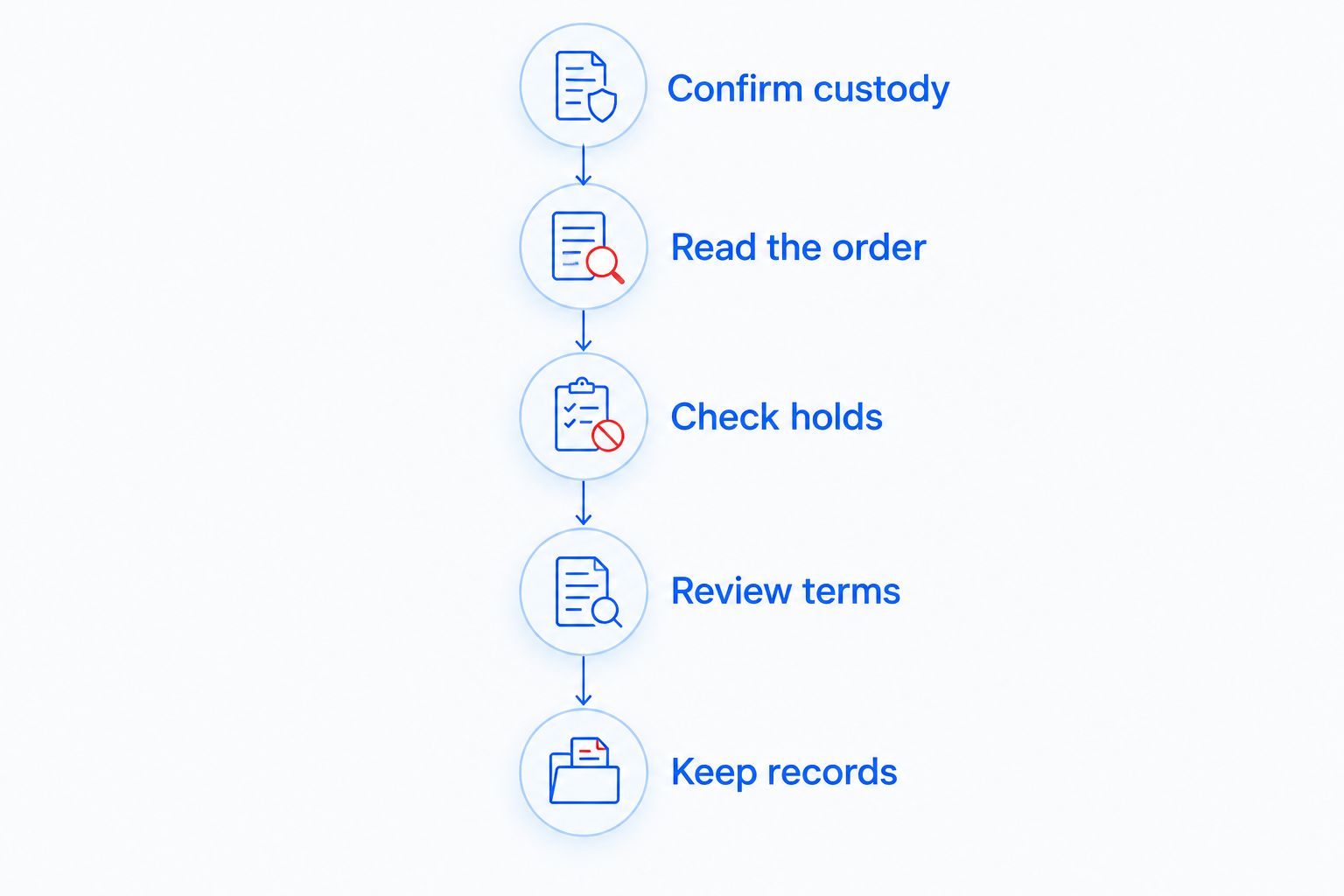
Use this sequence:
- Confirm custody. Identify the jail, booking record, and controlling court.
- Read the order. Confirm the permitted release method and any restrictions.
- Check holds. Ask whether another matter prevents release.
- Review terms. Understand the bond agreement or court deposit instructions.
- Keep records. Save signed documents and written payment information.
Keep financial records accurate and intact. If the court requests proof of the source of funds, ask counsel which documents to provide and how to submit them. Do not move money between people to disguise its origin.
For practical bond questions, you can contact a licensed bail agent. Ask for a plain-language explanation before deciding; an inquiry does not require you to sign an agreement.
How these options are ranked
This 2026 ranking puts an available state surety bond first, then separates payment arrangements from alternative release routes. The criteria are court eligibility, financial responsibility, co-signer exposure, custody barriers, licensed assistance, and written terms.
There is no universal winner across state and federal cases. A payment plan cannot fix an unavailable release order, and cash cannot remove a separate hold.
Which bail option should you choose?
Choose a licensed surety bond when a California state court permits it and the written obligations fit your circumstances. Consider a payment plan only after reviewing the full balance and schedule.
Choose cash bail only after confirming the deposit rules and the effect on your household funds. When the obstacle is detention, a source-of-funds order, or disputed conditions, start with defense counsel. Federal charges require the federal release process.
Jake Hernandez Bail Bonds provides 24-hour bail bond service for California families. That availability means you can seek assistance outside business hours; it is not a promise of release within a particular time.
FAQ
What are the best bail bond options for drug trafficking charges?
The best option depends on the court’s release order. A licensed surety bond fits an eligible California state case; cash bail, an approved payment plan, or an attorney-led release request address different financial and legal circumstances.
Can someone charged with drug trafficking get bail in California?
A drug trafficking charge alone does not establish whether bail is available. The controlling court order, applicable law, and any separate holds determine whether and how the person can be released.
Is a bond premium the same as a down payment?
No. The premium is the contractual charge for the commercial bond, while a down payment is an initial payment toward the agreed obligation. Read the entire payment schedule before signing.
Does a bail payment plan guarantee release?
No. A payment plan addresses the bond agreement, not the court’s authority or other custody restrictions. The defendant must still qualify for release under the applicable order.
What does a California source-of-funds restriction mean?
A source-of-funds restriction can require a court determination about whether bail funds were feloniously obtained under California Penal Code § 1275.1. Defense counsel should explain the specific order and the evidence required.
Can I use a California state bail bond for federal drug charges?
A California state bail bond does not substitute for a federal release order. Federal defense counsel should confirm the permitted release conditions and any court-required security.
What should I ask before co-signing a bail bond?
Ask what you owe, what collateral is required, and what happens if the defendant misses court or payments are missed. Read the indemnity agreement before accepting responsibility.
One last thing
Bail posted and release authorized are not the same thing. Before you commit funds in 2026, ask whether anything else prevents release after the proposed bond or deposit is accepted. That question is more useful than asking for a guaranteed release time.
This guide provides general information, not legal advice. Use a licensed agent for bond arrangements and defense counsel for advice about the court’s orders and your loved one’s case.