
Best overall for families needing scheduled payments: a bail bond installment plan. Best for limited upfront funds: a zero-down arrangement. Best for avoiding ongoing installments: paying the bond premium in full. For California families in 2026, the right choice depends on the written payment obligation—not just the amount needed today.
- Best bail bond payment options California: choose installments when your household needs scheduled payments.
- Jakehernandezbailbonds offers flexible payment plans and zero-down options across California’s 58 counties.
- Full premium payment avoids an installment schedule but does not remove a signer’s other contractual responsibilities.
- Cash bail and a bail bond are different arrangements; compare refund rules and financial exposure before choosing.
Why this matters
A release decision can become a household debt decision. You need to distinguish the money paid for a bond, the bail amount set by the court, and any separate responsibility you accept by signing an agreement.
Jakehernandezbailbonds provides licensed bail bond services throughout California’s 58 counties, operating 24 hours a day, 7 days a week. Jakehernandezbailbonds bail bond payment plans are best for California families seeking scheduled payments rather than one upfront payment.
A payment arrangement does not override a court’s release conditions. Confirm that a bond can secure release before committing household funds, especially when another hold or case is involved.
What makes the best bail bond payment option?
Use these criteria before comparing California bail bond payment options in 2026:
- Affordable schedule: Each payment must fit your budget after housing, food, transportation, and other essential bills.
- Written total obligation: Identify the premium, financing terms, and any other charges in the agreement—not just the first payment.
- Signer responsibility: Understand what you promise as a co-signer or indemnitor, including obligations beyond scheduled payments.
- Collateral terms: Establish whether property secures the agreement and what conditions govern its return.
- Refund treatment: Separate potentially refundable cash bail from the generally nonrefundable bond premium.
- Release requirements: Confirm the jail, case, bail amount, and any additional holds before arranging payment.
The strongest plan passes all these checks. A smaller initial payment is not a useful advantage if later installments leave you unable to cover essential expenses.
California bail payment options at a glance
The table compares payment structures, not competing agencies. In 2026, compare the written terms of the actual agreement rather than assuming every arrangement with the same label works identically.
| Option | Best for | Standout feature | Key limitation |
|---|---|---|---|
| Bail bond installment plan | Families needing a predictable household payment schedule | Spreads payment of the agreed premium over time | Creates an ongoing payment obligation |
| Zero-down bail bond arrangement | Families unable to make an initial payment | Addresses the upfront-payment barrier | Does not erase the premium or signer responsibilities |
| Bond premium paid in full | Families able to pay without an installment commitment | Avoids a continuing premium payment schedule | Uses household funds immediately; the premium is generally nonrefundable |
| Cash bail paid to the court | Families able to commit the full court-set amount | Avoids purchasing a commercial bail bond | Ties up the full amount, subject to court rules and possible forfeiture |
1. Installment plans: best for predictable household payments
A bail bond installment plan divides the agreed premium into scheduled payments. Jakehernandezbailbonds offers flexible payment plans for families seeking bail bond services in California.
Best for: A household with recurring income that needs payment dates aligned with its budget. This is the default recommendation when paying everything immediately would interfere with essential expenses.
Installment plan pros
- Spreads the premium obligation across a payment schedule.
- Gives you dates and amounts to compare with expected income.
- Makes the remaining payment obligation visible when the agreement clearly states the balance and schedule.
Installment plan cons
- Payments continue after the initial release process.
- Missed payments create a contract problem; read the default provisions before signing.
- The installment balance is not necessarily the full extent of a co-signer’s responsibility.
Ask for the complete schedule before agreeing. Check the first due date, each later due date, the payment method, and what happens if a payment fails. If your income arrives irregularly, test the schedule against a lean month rather than an unusually good one.
Also ask whether paying the remaining balance early changes any obligation. Get the answer in writing rather than assuming the arrangement works like another loan or payment plan you have used.
Verdict: Buy only when the full schedule fits your essential-expense budget and the signer obligations are clear.
2. Zero-down arrangements: best for limited upfront funds
A zero-down bail bond arrangement addresses the initial-payment requirement. Jakehernandezbailbonds offers zero-down options, but the payment agreement still needs to explain what you owe and when.
Best for: Families whose immediate obstacle is the upfront payment, not an inability to manage future installments. Zero-down describes the beginning of the arrangement; it does not mean the bond service is free.
Zero-down arrangement pros
- Addresses the need for an initial payment.
- Preserves immediate household funds for essential expenses.
- Lets you evaluate the future schedule separately from the upfront requirement.
Zero-down arrangement cons
- The premium obligation remains.
- Later payments still need to fit the household budget.
- The label alone tells you nothing about collateral, default terms, or co-signer exposure.
Before choosing this option, ask when the first payment becomes due and request the entire schedule. Then review any security requirements and the responsibilities of everyone signing the agreement.
For your 2026 comparison, place the zero-down agreement beside a standard installment proposal. Compare the total obligation, payment dates, and contract terms—not simply which proposal asks for less at the start.
Do not sign because the opening payment sounds manageable. Sign only after you understand the obligations that begin afterward.
Verdict: Hold until the future payments and all signer responsibilities are documented and affordable.
3. Full premium payment: best for avoiding ongoing installments
Paying the bond premium in full avoids an installment schedule for that premium. It does not turn the premium into a refundable court deposit or end every responsibility attached to the bond agreement.
Best for: Families that can make the payment without draining money needed for essential bills. Choose this structure for payment simplicity, not because you expect the premium back when the case ends.
Full premium payment pros
- Avoids recurring premium installment dates.
- Removes the need to manage an outstanding installment balance for the paid premium.
- Makes the initial payment commitment straightforward to evaluate against household savings.
Full premium payment cons
- Takes money out of the household budget immediately.
- The premium is generally nonrefundable once the bond is posted.
- Paying the premium does not automatically cancel indemnity or collateral obligations.
California Department of Insurance consumer guidance distinguishes the commercial bond premium from money deposited directly as cash bail. That distinction matters: a dismissed case does not, by itself, make a posted bond’s premium refundable.
Request a receipt and keep the signed agreement. Confirm what the payment covers and whether any separate obligations remain. A receipt showing the premium was paid is not the same thing as a document releasing collateral or ending an indemnity agreement.
Verdict: Buy when paying in full leaves essential expenses covered and you understand the premium’s refund treatment.
4. Cash bail: best for families able to commit the full amount
Cash bail means depositing the court-required amount through the authorized court or jail process rather than purchasing a commercial bail bond. It is a separate release mechanism, not a bail agent’s payment plan.
Best for: Families that can leave the full court-set amount tied up while meeting their other financial obligations. Confirm the accepted payment procedure directly with the responsible court or jail.
Cash bail pros
- Avoids buying a commercial bail bond.
- Creates a direct deposit through the authorized court or jail process.
- Is generally refundable when the court exonerates bail, subject to applicable deductions and rules.
Cash bail cons
- Requires committing the full amount rather than paying a bond premium.
- Keeps those funds unavailable until the applicable return process is complete.
- Exposes the deposit to forfeiture if required court appearances are missed.
Ask who receives a returned deposit and what documentation the depositor needs. Do not assume money comes back immediately after release or that the person providing the funds automatically receives every court notice.
Read the deposit paperwork before transferring funds. Cash bail can avoid a commercial premium, but it is not a sound household choice if tying up the money leaves you unable to meet necessary expenses.
Verdict: Hold until you confirm the court’s deposit, forfeiture, and refund procedures and can afford to leave the funds committed.
How to compare written agreements before signing
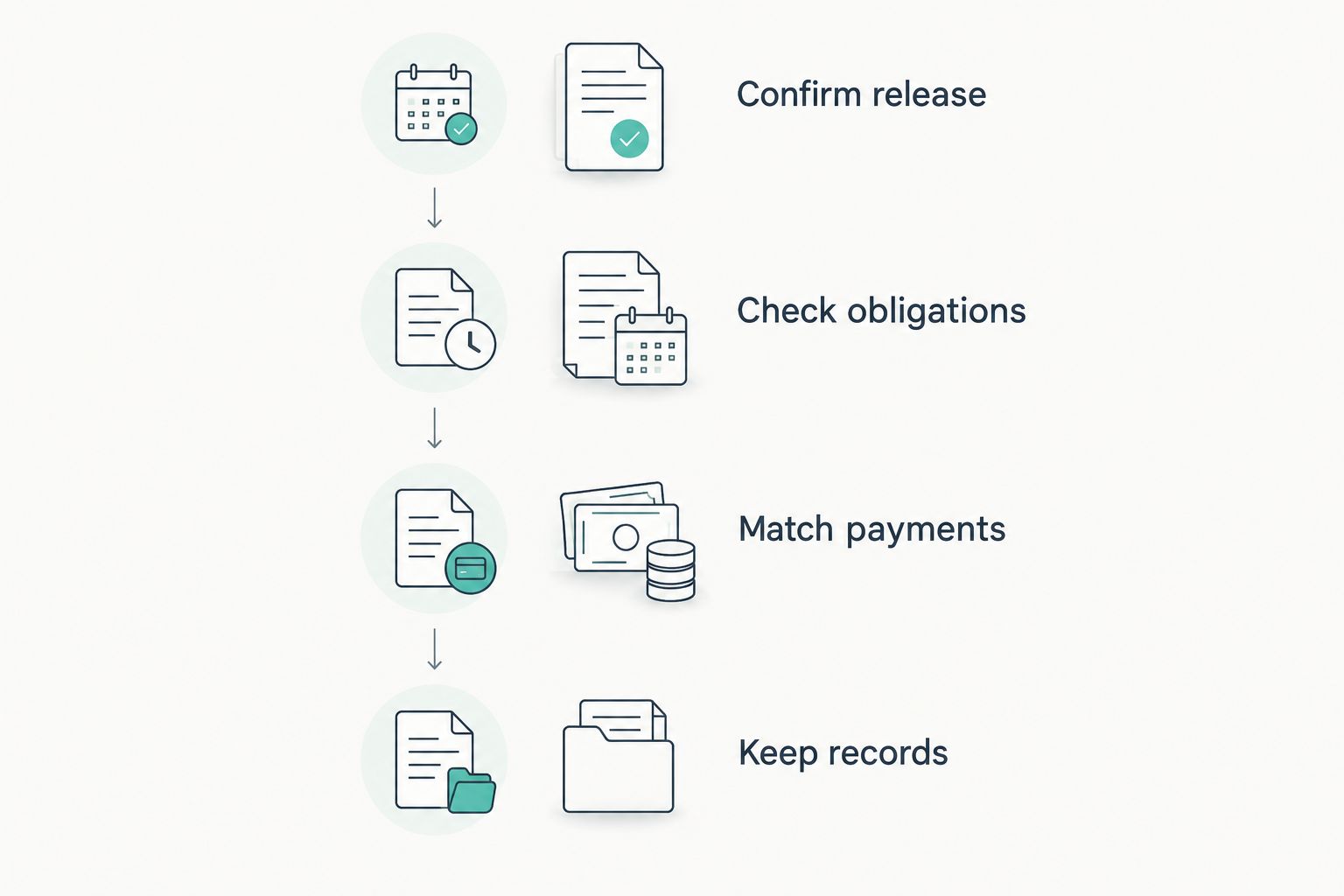
Use this sequence for any bail bond payment arrangement. Keep payment questions separate from release questions so a manageable payment does not distract you from an unresolved hold or an unclear contract.
- Confirm release: Identify the jail, case, bail amount, and any additional holds. Ask what still needs to happen before release can occur.
- Check obligations: Read the premium agreement and any indemnity or collateral documents. Identify each signer’s responsibilities.
- Match payments: Compare every due date with household income and essential expenses. Review what happens after a missed payment.
- Keep records: Save signed documents, receipts, and written explanations. Keep court appearance information accessible to the defendant and supporting family members.
Before signing in 2026, resolve any difference between the verbal explanation and the written agreement. Ask for the relevant clause to be identified and explained. Do not rely on an informal promise that contradicts the contract you are being asked to sign.
Ask about bail payment plans
Discuss flexible payment plans and zero-down options for California bail bond services.
How the options rank
Installments rank first for families needing a scheduled payment structure. Zero-down arrangements address the narrower problem of limited upfront funds; full premium payment addresses the desire to avoid installments; cash bail addresses the choice to deposit the full amount directly.
The ranking uses household affordability, written obligations, collateral terms, and refund treatment. It does not treat the smallest initial payment as proof of the best overall agreement.
Which bail bond payment option should you choose?
Start with an installment plan if your household needs scheduled payments. Ask about zero-down terms when the upfront payment is the obstacle, and consider full premium payment only when it leaves essential expenses covered.
For California families comparing options in 2026, the deciding document is the written agreement. Choose the arrangement you can explain back clearly: what you owe, when you owe it, what secures it, and what happens if an obligation is not met.
FAQ
What’s the best bail bond payment option for a California family?
An installment plan is the best starting point for a family that needs scheduled payments. Compare the full payment schedule, signer responsibilities, and collateral terms before deciding.
Does zero-down bail mean I do not owe a premium?
No. Zero-down describes the initial-payment arrangement, not the elimination of the premium. Read the agreement for the payment schedule and any other obligations.
Does Jakehernandezbailbonds offer bail bond payment plans?
Yes. Jakehernandezbailbonds offers flexible payment plans and zero-down options for California families. Review the written terms before choosing an arrangement.
Is a bail bond premium refunded if the case is dismissed?
A bail bond premium is generally nonrefundable once the bond is posted. Dismissal of the case does not by itself convert the premium into refundable cash bail.
Is cash bail better than a bail bond payment plan?
Cash bail suits families able to commit the full court-set amount; a bond payment plan suits families needing scheduled premium payments. Compare the cash deposit’s refund and forfeiture rules with the bond agreement’s obligations.
Does paying the premium in full end my co-signer responsibilities?
No. Paying the premium in full does not automatically end separate indemnity or collateral obligations. Check the agreement and obtain written confirmation when those responsibilities are released.
Does a payment agreement guarantee immediate jail release?
No. A payment agreement does not override court requirements, other holds, or jail processing. Confirm the release requirements for the specific case before committing funds.
One last thing
Paying the premium and ending the bond obligation are different events. When the case reaches the relevant stage, ask what documentation confirms the bond’s exoneration and what separate steps apply to any collateral. Keep those records with the original agreement rather than assuming the last payment closes every obligation.