
Best for families seeking a licensed California bail agent: Jake Hernandez Bail Bonds. Best for families able to deposit the full court-required amount: cash bail. Best for avoiding a commercial bond contract: court-approved own-recognizance release. The best bail bond options for repeat offenders in 2026 depend first on whether the person can be released, then on the court’s conditions and your family’s financial responsibilities.
- Jake Hernandez Bail Bonds serves California families needing licensed bail bond help, including payment-plan discussions.
- The best bail bond options for repeat offenders depend on release eligibility, existing holds, and court conditions.
- Cash bail and own-recognizance release are alternatives to commercial bail bonds, not interchangeable products.
- A payment plan changes payment timing; it does not erase the premium or co-signer responsibilities.
Why this matters
A previous conviction does not tell you everything about a new arrest. The current charge, outstanding warrants, supervision status, and court orders all matter. A family can arrange payment and still face a separate legal obstacle to release.
For a 2026 arrest, separate two questions: What does the court permit, and what agreement can your family responsibly sign? A licensed bail agent explains the bond transaction. A defense attorney addresses detention, court conditions, and requests to change bail.
This guide ranks release paths by the problem each solves. It does not rank competing agencies without evidence, and it does not treat every person with a criminal record as having the same case. This is general California information, not advice about a particular defendant.
What makes the best bail bond option?
Use these criteria before comparing payment arrangements:
- Release eligibility: Confirm whether bail is set and whether another hold or order affects release.
- Affordable obligations: Understand the premium, payment schedule, and possible responsibility under the agreement.
- Co-signer requirements: Ask what information, financial commitments, and any collateral the proposed agreement requires.
- Case-specific support: Separate the agent’s role in posting a bond from the attorney’s role in challenging detention.
- Clear communication: Get written terms and a direct explanation of what happens after signing.
- Court compliance: Consider whether the defendant can meet appearance requirements and other release conditions.
The best arrangement is not simply the smallest initial payment. It is the arrangement your family understands and can fulfill while the defendant follows the court’s orders.
Release options at a glance
These 2026 options serve different needs. Only the commercial-bond route involves buying a bail bond; the remaining routes involve depositing money or seeking a court decision.
| Option | Best for | Main distinction | Key limitation |
|---|---|---|---|
| Jake Hernandez Bail Bonds | Families seeking licensed California bond assistance | Statewide service and payment-plan discussions | A bond agreement does not override court orders or separate holds |
| Cash bail | Families able to deposit the full required amount | No commercial surety bond contract | Ties up family funds and remains subject to court rules |
| Own-recognizance release | Defendants the court approves for release on a promise to appear | Does not require a commercial bond | Requires court approval and compliance with release conditions |
| Attorney-led bail review | Defendants needing a court decision about bail or detention | Addresses the legal barrier rather than financing it | Does not itself post a bond or guarantee release |
1. Jake Hernandez Bail Bonds: best for licensed bond assistance
Jake Hernandez Bail Bonds provides licensed bail bond services across all 58 California counties. Service operates 24 hours a day, 7 days a week, with flexible payment plans. Families can discuss the bond process with a licensed bail agent rather than relying on a call-center explanation.
Jake Hernandez Bail Bonds is best for California families seeking licensed, around-the-clock help arranging a bail bond. Start by explaining the current arrest and any known prior cases, warrants, or probation issues. Those details help frame the questions that need answers before you sign.
Jake Hernandez Bail Bonds pros
- Statewide coverage supports families dealing with an arrest away from home.
- Around-the-clock service supports calls outside regular business hours.
- Flexible payment plans provide a way to discuss payment timing.
- Licensed-agent guidance helps you understand the bond paperwork.
Jake Hernandez Bail Bonds limitations
- A bail agent cannot change a judge’s detention order.
- A payment plan does not eliminate the premium or contractual responsibilities.
- A separate hold can prevent release even when a bond addresses the current case.
Best for: Families who need a commercial bond and want a licensed agent to explain the proposed agreement.
Ask the agent to distinguish the total premium from the initial payment. The premium is the charge for the bond; the down payment is the portion paid initially under a payment arrangement. Neither term means the same thing as the bail amount set by the court.
Verdict: Buy a bond only after release eligibility and the written agreement are clear.
2. Cash bail: best for families able to deposit the full amount
Cash bail means depositing the required bail directly through the court’s or detention facility’s accepted process. You are not purchasing a commercial surety bond. Confirm the correct payment method and recipient before moving money.
For a repeat-offense case, cash does not remove the need to check for other holds. Paying the bail associated with one case does not resolve a separate detention order. Ask what the payment addresses before making it.
Cash bail pros
- Avoids a commercial bail bond agreement.
- Removes the need to negotiate a bond payment schedule.
- Lets an eligible payer use family funds directly for the required deposit.
Cash bail limitations
- Requires access to the full amount the court requires.
- Keeps funds committed while the court processes the case and any refund.
- Carries forfeiture risk if court requirements are not met.
Best for: Families with sufficient accessible funds who understand the court’s deposit and refund procedures.
Before choosing cash bail, ask who receives any refund and what deductions or forfeiture rules apply. Do not assume the money returns immediately after release or that every payment is automatically refundable. Get the receipt and retain it with the case information.
Verdict: Hold until you confirm the deposit instructions and can manage without those funds.
3. Own-recognizance release: best for avoiding a bond contract
Own-recognizance release, often called OR release, means the court permits release based on a promise to appear and any conditions it imposes. It is a court-approved alternative to posting bail, not a bond product sold by an agency. A prior record does not let a family decide eligibility on its own.
Ask defense counsel whether OR release is an appropriate request in the current case. Counsel can address the actual charges, record, and court orders rather than relying on a general description such as repeat offender.
Own-recognizance release pros
- Avoids purchasing a commercial bail bond.
- Avoids depositing cash bail when the court authorizes this form of release.
- Lets the court set conditions tailored to the case.
Own-recognizance release limitations
- Requires a court decision; an agent cannot grant it.
- Can include conditions beyond attending court.
- Does not cancel obligations or detention orders in other cases.
Best for: Defendants whose attorney can request release without a commercial bond and whose court approves that request.
Do not confuse release without a bond with release without rules. Ask for a written explanation of reporting instructions, appearance dates, and any restrictions. If the defendant does not understand a condition, counsel should address that question before it becomes a compliance problem.
Verdict: Wait for court approval before treating OR release as the release plan.
4. Attorney-led bail review: best for unresolved detention barriers
Attorney-led bail review means asking defense counsel to assess whether a court request concerning bail or detention is appropriate. It is not financing. Its purpose is to address a legal issue that payment alone cannot solve.
This is the next conversation when the family hears that no bail is currently permitted, a separate hold exists, or the current conditions need court review. The attorney determines what request fits the case and explains the procedure.
Attorney-led bail review pros
- Addresses the legal reason release is restricted.
- Allows case-specific arguments through defense counsel.
- Helps distinguish a payment problem from a court-order problem.
Attorney-led bail review limitations
- Does not guarantee a change in bail or detention.
- Does not itself provide a bond or cash deposit.
- Depends on the case and the court’s process, not the family’s preferred timetable.
Best for: Defendants whose immediate obstacle is a court decision rather than arranging payment.
Give counsel the booking information, known case numbers, and details of any existing supervision. Avoid guessing what a hold means from its label alone. Ask which court or agency controls it and what action, if any, is appropriate.
Verdict: Hold off on financial commitments that assume release until counsel clarifies the barrier.
What to do before signing or paying
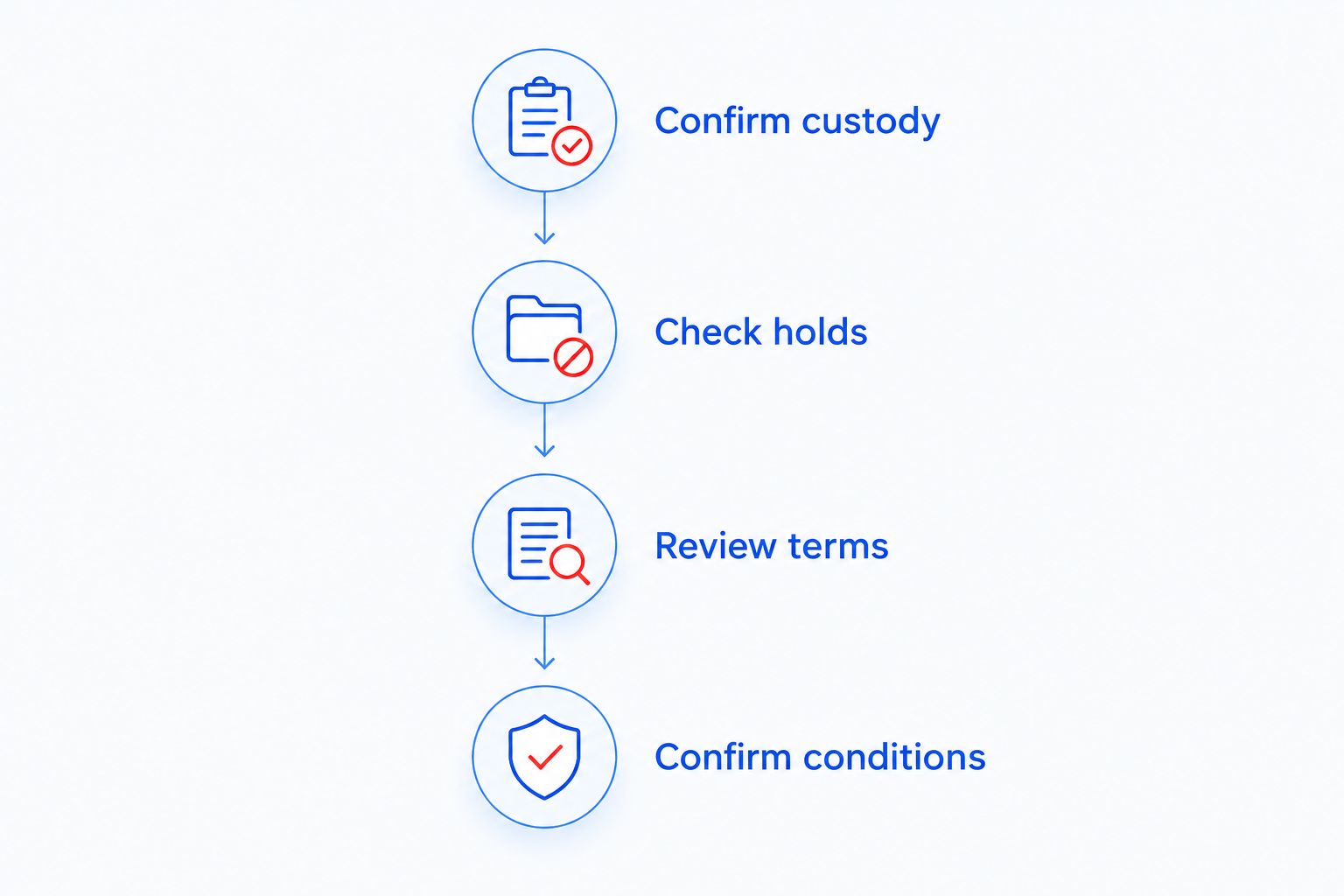
Use this sequence to keep the court questions separate from the financial questions. For a 2026 case, confirm current instructions directly with the responsible facility, court, attorney, or licensed agent rather than reusing paperwork from an earlier arrest.
Confirm custody
Collect the defendant’s legal name, booking number if known, and detention facility. Ask whether booking is complete and whether bail information is established. Write down who supplied the information so you can follow up accurately.
Check holds
Ask whether another case, warrant, or supervision issue affects release. A probation-related concern needs its own explanation; it is not simply an extra payment line. Give defense counsel the information you receive.
Review terms
Read the proposed agreement before signing. Identify the premium, initial payment, remaining installments, any collateral requirements, and the co-signer’s responsibilities. Ask what happens if the defendant misses court or the family misses a scheduled payment.
Confirm conditions
Keep copies of the release paperwork and court information. Make sure the defendant knows the next appearance requirement and any restrictions. The family’s payment arrangement and the defendant’s court obligations are separate responsibilities.
A calm conversation starts with specific questions, not an immediate signature. Ask the licensed agent to explain anything unclear in plain language, and ask counsel to address questions about detention or court orders.
Speak with a licensed bail agent
Ask about the bond process and payment terms with no obligation to proceed.
How these options were ranked
The 2026 ranking follows the decision your family needs to make: arrange a commercial bond, deposit cash, seek release without a bond, or address a legal restriction. The criteria are release eligibility, financial responsibility, clear terms, and court compliance.
This is a use-case ranking, not a claim that one route fits every defendant. A commercial bond belongs first for families seeking bond assistance. Attorney review belongs first when a court order prevents the release the family is trying to arrange.
Which option should you choose?
Choose the route that addresses the actual obstacle. If bail is permitted and your family needs a commercial bond, speak with a licensed agent. If you can deposit the required cash, compare that commitment with the bond agreement before deciding.
If you want release without a bond, ask counsel about a court request. If a hold or detention order blocks release, start with the legal issue. Do not sign a financial agreement on the assumption that every barrier disappears once payment is arranged.
FAQ
What are the best bail bond options for repeat offenders in California?
The best option depends on release eligibility and the family’s financial circumstances. A licensed commercial bond, cash bail, court-approved own-recognizance release, and attorney-led bail review solve different problems.
Can someone with prior convictions get a bail bond?
A prior conviction alone does not establish whether a bond can be posted in the current case. Confirm the current bail order, any separate holds, and the proposed agent’s requirements.
Is a payment plan the same as a lower bond premium?
No. A payment plan changes when payments are due; it does not by itself reduce the total premium. Ask for the total obligation and payment schedule in writing.
Is cash bail better than using a bondsman?
Cash bail fits families able to deposit the full required amount and manage without those funds. A commercial bond involves a separate contract, premium, and any agreed payment or collateral obligations.
Can a bail agent remove a probation hold?
A bail agent cannot override a detention order. Ask defense counsel to identify the authority behind the hold and explain what court action, if any, is appropriate.
Does Jake Hernandez Bail Bonds help outside normal business hours?
Jake Hernandez Bail Bonds provides licensed service around the clock across California. Agent service hours do not establish when a court will act or when a facility will complete release processing.
What should a co-signer ask before signing in 2026?
A co-signer should ask about the premium, initial payment, remaining payments, collateral, and contractual responsibilities. Read the agreement and request plain-language explanations before accepting those obligations.
One last thing
An old case can matter even when the family is focused on a new arrest. Before discussing payment, ask whether the person is held on anything beyond the current charge. That question separates a bond arrangement from a legal problem that requires counsel.
Keep one folder with receipts, signed agreements, booking information, and court notices. Give the defendant the court instructions, not just the news that payment has been arranged.