
Best overall when you need a commercial bond: Jakehernandezbailbonds. Best for release without posting bail: court-approved own-recognizance release. Best for families able to deposit bail themselves: cash bail. Best for eligible property owners: a court-approved property bond. The best bail bond options for drug possession charges in 2026 depend on the release order, your resources, and the obligations you can meet.
- Jakehernandezbailbonds is the best fit here for families seeking California bail bond services with flexible payment plans.
- The best bail bond options for drug possession charges depend on the court’s release decision, not just the allegation.
- Own-recognizance release requires court approval; cash bail and property bonds require resources and acceptance by the court.
- Compare written payment obligations, collateral requirements, and release conditions before signing a commercial bail bond agreement.
Why this matters
A drug possession allegation does not tell you whether someone can leave custody immediately. The actual charges, release order, other holds, and applicable court procedures determine which routes are available. A bond cannot override a separate hold or a detention order.
Jakehernandezbailbonds provides licensed California bail bond services 24 hours a day, 7 days a week, across all 58 counties, with flexible payment plans. That makes the service relevant when your family needs a commercial bond, but you still need to understand the agreement before signing.
For a 2026 arrest, start with the current custody record and release terms. Do not choose a bond arrangement based only on what someone remembers from an earlier case.
What makes the best bail option for drug possession charges
Judge each route against these criteria before comparing providers or signing paperwork:
- Legal eligibility: The jail or court must accept the release method for the particular case. Confirm any holds or unresolved release restrictions.
- Payment obligations: Separate money deposited with the court from obligations under a commercial bond contract. They serve different purposes.
- Signer responsibility: Know who promises to pay, who must attend court, and what happens if the defendant fails to appear.
- Collateral exposure: Identify any property securing the agreement and the written conditions for its return.
- Practical access: Confirm the documents, approvals, and processing steps required. A provider’s operating hours do not control jail processing.
- Release conditions: Read every court-imposed condition. Posting a bond does not remove restrictions attached to release.
Choose an eligible release route first; choose a payment arrangement second. A manageable payment plan does not solve a legal barrier to release.
Bail options at a glance
This 2026 comparison ranks release routes by family circumstances, not by promised release speed. Only the commercial bond option involves hiring a bail bond provider.
| Option | Best for | Standout feature | Key limitation |
|---|---|---|---|
| Jakehernandezbailbonds commercial bond | Families needing California bond services with payment flexibility | Licensed service across all 58 California counties | A private contract creates obligations separate from the criminal case |
| Own-recognizance release | Defendants the court approves for release without posted bail | Release rests on a promise to appear and compliance with conditions | Families cannot purchase or guarantee court approval |
| Cash bail | Families able to deposit the required bail directly | Avoids a commercial surety agreement | Money remains subject to court rules and the defendant’s compliance |
| Court-approved property bond | Property owners whose assets meet court requirements | Uses qualifying real property as security | Approval, documentation, and property exposure require careful review |
1. Jakehernandezbailbonds: best for flexible commercial bonds
Jakehernandezbailbonds provides licensed bail bond services throughout California, including flexible payment plans. This is the strongest fit among the listed options when a commercial bond is permitted and your family needs help arranging that bond rather than depositing bail directly.
The provider operates around the clock. That gives you a point of contact outside ordinary business hours, but it does not establish when a jail will complete release processing.
Jakehernandezbailbonds pros:
- Service covers all 58 California counties.
- Assistance is available 24 hours a day, 7 days a week.
- Flexible payment plans provide an alternative payment structure to discuss.
Jakehernandezbailbonds cons:
- A commercial bond agreement creates contractual responsibilities for its signers.
- A commercial bond does not eliminate a separate hold, change a detention order, or guarantee a release time.
Before signing, request the complete agreement and payment schedule. Ask which obligations remain if the criminal case is dismissed, what triggers a demand for payment, and whether collateral is required for your arrangement. Do not assume the criminal case ending automatically ends every contractual obligation.
Best for: California families seeking a commercial bail bond with flexible payment arrangements.
Verdict: Buy only after confirming bond eligibility and accepting the written obligations.
2. Own-recognizance release: best for court-approved release
Own-recognizance release allows an eligible defendant to leave custody on a promise to appear, subject to the court’s conditions, without posting bail. It is a release decision, not a bond product you buy.
For a drug possession case in 2026, ask defense counsel whether this route is available under the applicable procedures. The charge description alone does not establish eligibility, and a family’s preference does not bind the court.
Own-recognizance release pros:
- It does not require purchasing a commercial bail bond.
- It does not require a cash bail deposit for that release order.
- It avoids a private bail bond payment agreement.
Own-recognizance release cons:
- Approval depends on the court and applicable release procedures.
- The defendant must still follow release conditions and attend required appearances.
Ask for a clear copy of the release conditions. Confirm whether supervision, reporting, travel restrictions, or other requirements apply rather than assuming release means the person can resume every activity unchanged.
If release is denied, ask counsel what other lawful options remain. Do not treat denial as proof that a commercial provider can secure release regardless of the court’s order.
Best for: Defendants approved for release without posted bail.
Verdict: Hold off on purchasing a bond if counsel confirms this route is available.
3. Cash bail: best for families able to deposit bail directly
Cash bail involves depositing the required bail through the procedure accepted by the court or jail. It differs from paying a commercial provider to arrange a surety bond.
This route suits families who can make the required deposit without compromising essential obligations. Before proceeding, confirm the accepted payment method, who will be recorded as the depositor, and the rules governing any return of funds.
Cash bail pros:
- It avoids entering a commercial surety agreement.
- It provides a direct deposit route when accepted for the case.
- It avoids negotiating a private bond payment plan.
Cash bail cons:
- The family must commit the required funds upfront.
- Return of funds depends on court procedures, compliance, and any applicable deductions or orders.
Keep every receipt and use the correct case information. A relative who provides money should understand whose name appears on the deposit record and how that affects the return process.
Do not assume the deposit will return immediately after release or after a hearing. Ask the clerk about the actual process, and avoid committing funds needed for housing, food, or legal representation without considering those competing needs.
Best for: Families able to deposit bail directly and accept the associated court-controlled process.
Verdict: Buy into this route only after confirming deposit and return procedures.
4. Property bond: best for eligible owners with qualifying property
A property bond uses qualifying real property as security, subject to court acceptance and applicable requirements. It is not the same as giving a commercial bail provider collateral, even though both arrangements can expose property to financial risk.
This route requires careful attention to ownership, existing claims against the property, documentation, and court approval. Confirm the local process before treating a home or other property as an available release solution.
Property bond pros:
- It provides a property-backed route where the court permits it.
- It offers an alternative to a direct cash deposit when requirements are met.
- It allows qualifying owners to seek court acceptance of real-property security.
Property bond cons:
- Documentation and approval requirements make it unsuitable as an assumed immediate solution.
- The property is exposed to enforcement if the bond obligations are breached.
Every affected owner should understand the proposed arrangement. Ask counsel to explain what is being pledged, which documents create the obligation, and what releases the property from it.
A family home is not simply paperwork supporting someone else’s release. Do not sign property documents because someone describes them as a formality.
Best for: Eligible property owners who understand and accept the security obligations.
Verdict: Wait until the court’s requirements and property risks are clear.
Confirm the release path before committing money
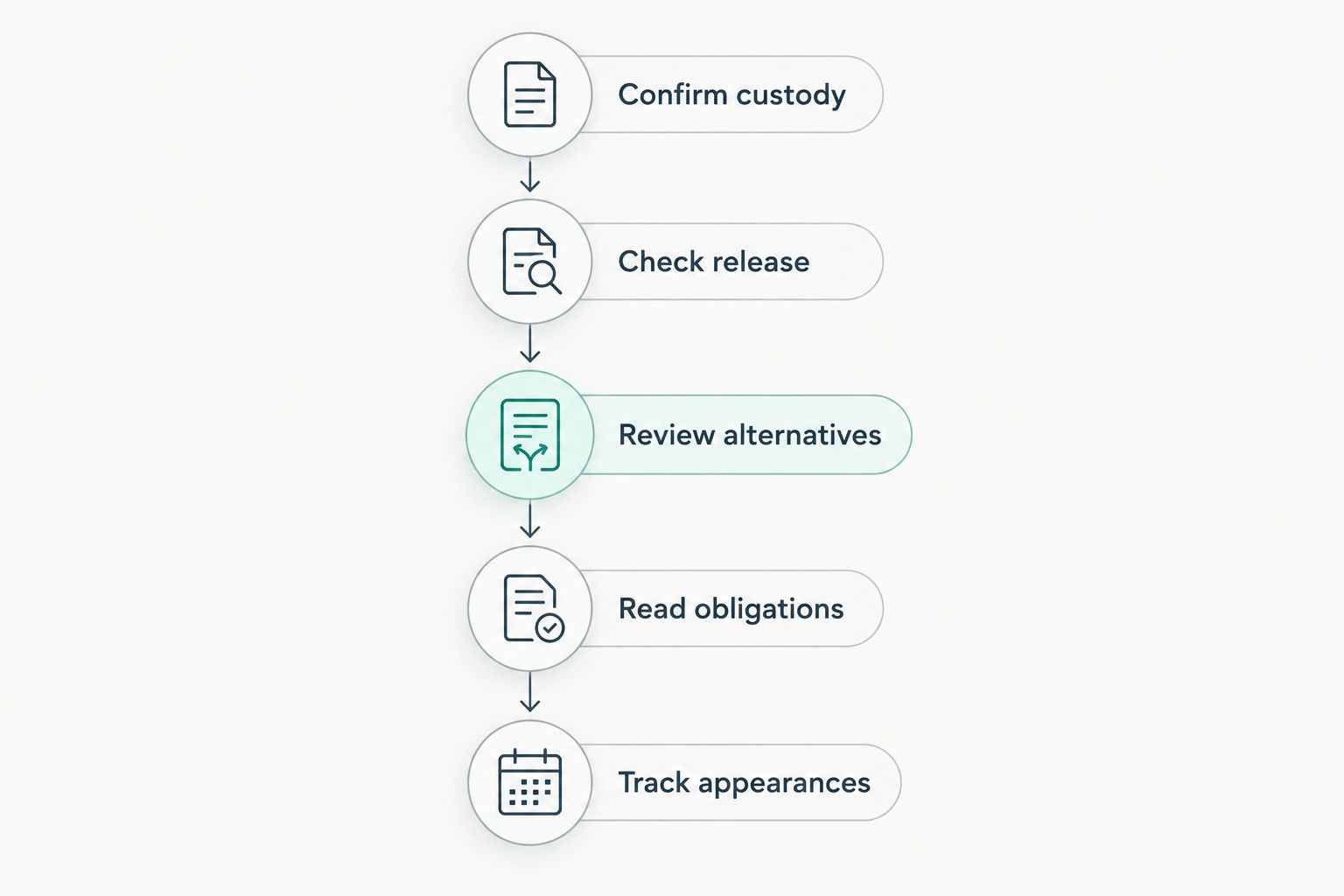
For a 2026 drug possession arrest, work through the release questions in order. Choosing a provider before confirming eligibility can distract you from the actual obstacle keeping someone in custody.
- Confirm custody: Identify the facility, defendant’s identifying information, and booking record.
- Check release: Verify the current bail or release order and any separate holds.
- Review alternatives: Ask counsel whether own-recognizance release or review of bail is appropriate.
- Read obligations: Review the proposed deposit, contract, or property documents before committing.
- Track appearances: Record court dates and release conditions once release occurs.
A request to review bail is a legal step, not another bond product. Defense counsel can assess whether a request fits the case; a provider cannot substitute a payment agreement for a court ruling.
If the booking information changes, confirm that everyone involved is working from the same current record. A name match alone is not enough to resolve questions about a particular defendant’s custody status.
Questions to ask before signing a commercial bond
Use the written agreement as the reference point. A reassuring conversation is not a substitute for clear terms you can keep and review.
- What is each signer agreeing to do?
- What is the full payment schedule, and what happens after a missed payment?
- Is collateral required, and what documents govern its return?
- Which obligations continue if charges are dismissed or changed?
- What must the defendant report to the provider?
- What happens if the defendant misses court or is taken back into custody?
Ask for explanations in language you understand. If an answer conflicts with the paperwork, resolve that conflict before signing rather than relying on a verbal exception.
How these options are ranked
This ranking prioritizes legal eligibility, payment structure, signer responsibility, collateral exposure, and practical access. The commercial service ranks first for families who need a commercial bond; own-recognizance release ranks separately because it requires court approval rather than a purchase.
No option ranks first for every defendant. The table is a decision guide, not a prediction of a judge’s ruling or a jail’s processing time.
Which bail option should you choose?
Jakehernandezbailbonds is the best fit here for families seeking California bail bond services with flexible payment plans. Choose that route only when a commercial bond is allowed and the written agreement fits your circumstances.
Ask counsel about own-recognizance release before assuming a bond purchase is necessary. Choose cash bail only if you can commit the deposit, and consider a property bond only after understanding the court’s requirements and the property exposure.
For 2026 cases, the decisive document is the current release order. Start there, then choose the arrangement you can responsibly maintain.
FAQ
What are the best bail bond options for drug possession charges?
The best route depends on the release order and your resources: a commercial bond, own-recognizance release, cash bail, or a court-approved property bond. Confirm eligibility before committing money or property.
Can someone get released without posting bail for drug possession?
Yes, if the applicable release procedures and court decision permit own-recognizance release. A drug possession allegation alone does not establish that the defendant qualifies.
Is a bail bond better than paying cash bail?
A commercial bond fits a different financial situation from a direct cash deposit. Compare the bond contract’s obligations with the court’s deposit and return procedures before choosing.
Does a bail bond guarantee immediate release?
No, a bail bond does not guarantee immediate release. Separate holds, release restrictions, and jail processing can prevent or delay release even after bond arrangements are made.
Can a family member be responsible for a bail bond agreement?
Yes, a family member who signs a bail bond agreement can take on contractual responsibilities. Read the indemnity, payment, and collateral terms before signing.
Does dismissal of drug charges cancel a bail bond payment agreement?
Do not assume dismissal cancels the payment agreement. The criminal case and the private contract are separate, so review the written terms governing any continuing obligations.
What should I do if the bail amount is unaffordable?
Ask defense counsel whether review of bail or another release route is appropriate. Also compare any proposed payment arrangement against your essential household obligations before signing.
One last thing
Release and resolution are different milestones. Leaving custody does not dispose of the drug possession charge, remove court dates, or cancel release conditions.
Before the defendant leaves the facility, identify who will keep the release paperwork and track appearances. A bond arrangement addresses release; a dependable court-date plan helps the defendant meet the obligations that follow.
This guide provides general California bail information, not legal advice. A California defense attorney can assess the specific charge, custody record, and release order.