
Best overall when bail is set and you need a licensed agent: Jakehernandezbailbonds. Best for release without posting bail: court-approved own-recognizance release; best for posting directly: cash bail; best for eligible property owners: a court-approved property bond. This 2026 guide compares the best bail bond options for assault charges by eligibility, financial responsibility, and release conditions.
- Jakehernandezbailbonds is best for families seeking licensed, around-the-clock bail bond assistance across California.
- The best bail bond options for assault charges depend on the court’s release order, not the charge label alone.
- Own-recognizance release avoids posting bail but requires court approval and compliance with release conditions.
- Cash bail and property bonds put your own assets at risk; a surety bond creates contractual obligations.
Why this matters
An assault arrest does not tell you whether someone can leave jail immediately. The actual charge, custody status, release order, and any separate holds determine the next step. A bond cannot override an order that prevents release.
Choose the release route before choosing how to fund it. Otherwise, you risk signing paperwork for a solution that does not address the reason your loved one remains in custody.
For a California family making this decision in 2026, the first useful question is not which company sounds fastest. It is whether bail is currently authorized and what conditions apply. Have an attorney address disputed detention or release conditions; have the jail confirm the current custody record.
What makes the best bail bond option for assault charges?
Judge each option against these criteria before making a commitment:
- Release eligibility: Does the court permit this route in the specific case? A scheduled bail amount does not resolve every custody restriction.
- Your financial responsibility: Identify what you must pay, pledge, or promise, and what happens if the defendant misses court.
- Contract clarity: Separate the bond agreement, any financing agreement, and any collateral agreement. Read each before signing.
- Release conditions: Ask about protective orders, contact restrictions, travel restrictions, and required appearances. Release does not cancel those obligations.
- Practical access: Confirm which documents, signatures, and approvals the jail, court, or agent actually needs.
- Exit requirements: Understand what ends your obligations and what documentation confirms that collateral or deposited funds can be returned.
The right choice fits the court order and your household’s capacity to meet its obligations. A convenient application is not a substitute for clear terms.
Bail options at a glance
| Option | Best for | Standout feature | Key limitation |
|---|---|---|---|
| Jakehernandezbailbonds surety bond service | Families needing licensed assistance after bail is authorized | Service operates 24 hours a day across all 58 California counties | A private agent cannot override a detention order; contract obligations still apply |
| Own-recognizance release | Defendants the court approves for release without posting bail | No bail deposit or surety bond is required | Approval is case-specific, and release conditions remain enforceable |
| Cash bail | Families able to deposit the required bail directly | The deposit goes through the authorized court or jail process | Funds remain committed until the applicable release and refund process allows their return |
| Court-approved property bond | Eligible property owners considering real estate as security | Uses qualifying property rather than a cash deposit | Court approval and property documentation are required; the property is exposed to forfeiture risk |
These are release routes, not interchangeable products. Own-recognizance release requires judicial approval, while cash, surety, and property arrangements depend on the applicable bail order and acceptance requirements.
1. Jakehernandezbailbonds: best bail bond assistance after bail is set
Jakehernandezbailbonds provides licensed bail bond services for families seeking release across all 58 California counties. Its service operates 24 hours a day, 7 days a week, and the business states that flexible payment plans are offered.
Jakehernandezbailbonds is best for California families seeking around-the-clock bail bond assistance after bail is authorized. That recommendation concerns service access and geographic coverage, not a promise of release or a ranking based on court outcomes.
Surety bond pros
- You can seek assistance outside ordinary business hours.
- Statewide coverage fits families dealing with custody in a different California county.
- A surety bond avoids depositing the entire cash bail amount directly with the court.
- Payment-plan discussions can address how contractual payments would be structured.
Surety bond cons
- A bail bond premium is generally nonrefundable; it is not the same as a refundable cash bail deposit.
- A cosigner can take on substantial obligations if the defendant fails to appear.
- Collateral or other contractual requirements can apply; obtain the actual terms before agreeing.
Best for: A family that has confirmed bail is authorized and wants a licensed agent to explain a surety bond arrangement.
Before signing in 2026, request the complete agreement and ask what remains owed if release is delayed, another hold exists, or the case ends. Do not assume installment payments remove liability under the bond agreement. Ask separately about collateral release and how the agent documents the end of your obligations.
Verdict: Buy only after confirming release eligibility and understanding the full contract.
2. Own-recognizance release: best for avoiding a bail deposit
Own-recognizance release allows an approved defendant to leave custody on a promise to appear and comply with the court’s conditions, without posting bail. The judge decides whether this route is appropriate under the applicable law and circumstances.
This is not a bond sold by a company. It belongs in the comparison because an approved release without bail removes the need to purchase a bond or deposit bail funds.
Own-recognizance release pros
- You do not need to post a bail deposit or purchase a surety bond.
- Household funds and property remain outside a bail security arrangement.
- The court can address release conditions directly through its order.
Own-recognizance release cons
- You cannot obtain it simply by choosing it; the court must approve release.
- Assault allegations can involve safety concerns that affect the release decision.
- Violating conditions or missing court can lead to consequences, including a warrant or return to custody.
Best for: A defendant whose attorney can seek, or whose court has already authorized, release without posting bail.
Ask defense counsel whether own-recognizance release is legally available and appropriate. Give counsel accurate information about residence, court attendance, employment, and other relevant circumstances rather than assuming any single factor guarantees approval.
A release order can still prohibit contact with a protected person. The defendant must follow that order even when a family member or the protected person asks for contact. Request clarification through counsel instead of interpreting an unclear condition independently.
Verdict: Hold off on purchasing a bond if own-recognizance release is already authorized; follow the court’s release instructions.
3. Cash bail: best for families able to post directly
Cash bail means depositing the required bail through the authorized court or jail process. The deposit secures the defendant’s attendance; it does not pay a lawyer, resolve the assault charge, or remove release conditions.
Cash bail differs from a surety bond because the money is deposited with the public authority rather than paid as a private bond premium. Return of the deposit depends on the court’s rules, case status, compliance, and any lawful deductions or orders.
Cash bail pros
- You use the court’s or jail’s direct bail process.
- You avoid purchasing a surety bond for that deposit.
- Deposited funds can be returned when the applicable legal requirements are satisfied.
Cash bail cons
- The required funds are unavailable for household use while held.
- Failure to appear can trigger forfeiture proceedings.
- A deposit receipt does not guarantee an immediate refund when the defendant leaves custody or the case ends.
Best for: A family that can commit the required funds without undermining essential household obligations.
For a 2026 cash bail decision, confirm accepted payment methods directly with the receiving authority. Ask whose name appears as the depositor, what receipt is issued, and how any eventual return is processed. Keep copies of the paperwork.
Do not send money based solely on an unexpected call or message claiming to represent a jail or court. Independently confirm the receiving office and its instructions before transferring funds.
Verdict: Buy only if the direct deposit is authorized and your household can manage the funds being tied up.
4. Court-approved property bond: best for eligible property owners
A property bond uses qualifying real estate as security for release, subject to court approval. The court determines what documentation and security are acceptable; owning a home does not automatically make this option available.
This route needs legal and financial scrutiny. You are considering an interest in property as security for another person’s compliance with court obligations.
Property bond pros
- Qualifying real estate can serve as security instead of a cash deposit.
- The court reviews the proposed security through its approval process.
- It provides a distinct route for an owner with suitable property but limited accessible cash.
Property bond cons
- Property eligibility and documentation requirements can prevent or delay approval.
- Ownership interests, existing liens, and consent requirements can complicate the proposal.
- Failure to comply with the bond conditions can put the pledged property at risk.
Best for: A property owner who has received case-specific legal advice and understands the potential exposure.
Ask the court what it requires before collecting documents or committing property. Discuss the arrangement with an attorney who can explain the consequences to the owner, including how the security is released when the obligation ends.
Do not confuse a court-approved property bond with collateral requested by a commercial bail agent. Both can involve property, but they are different arrangements with different paperwork and obligations.
Verdict: Wait until court acceptance requirements and the owner’s legal exposure are clear.
How to choose without making the situation worse
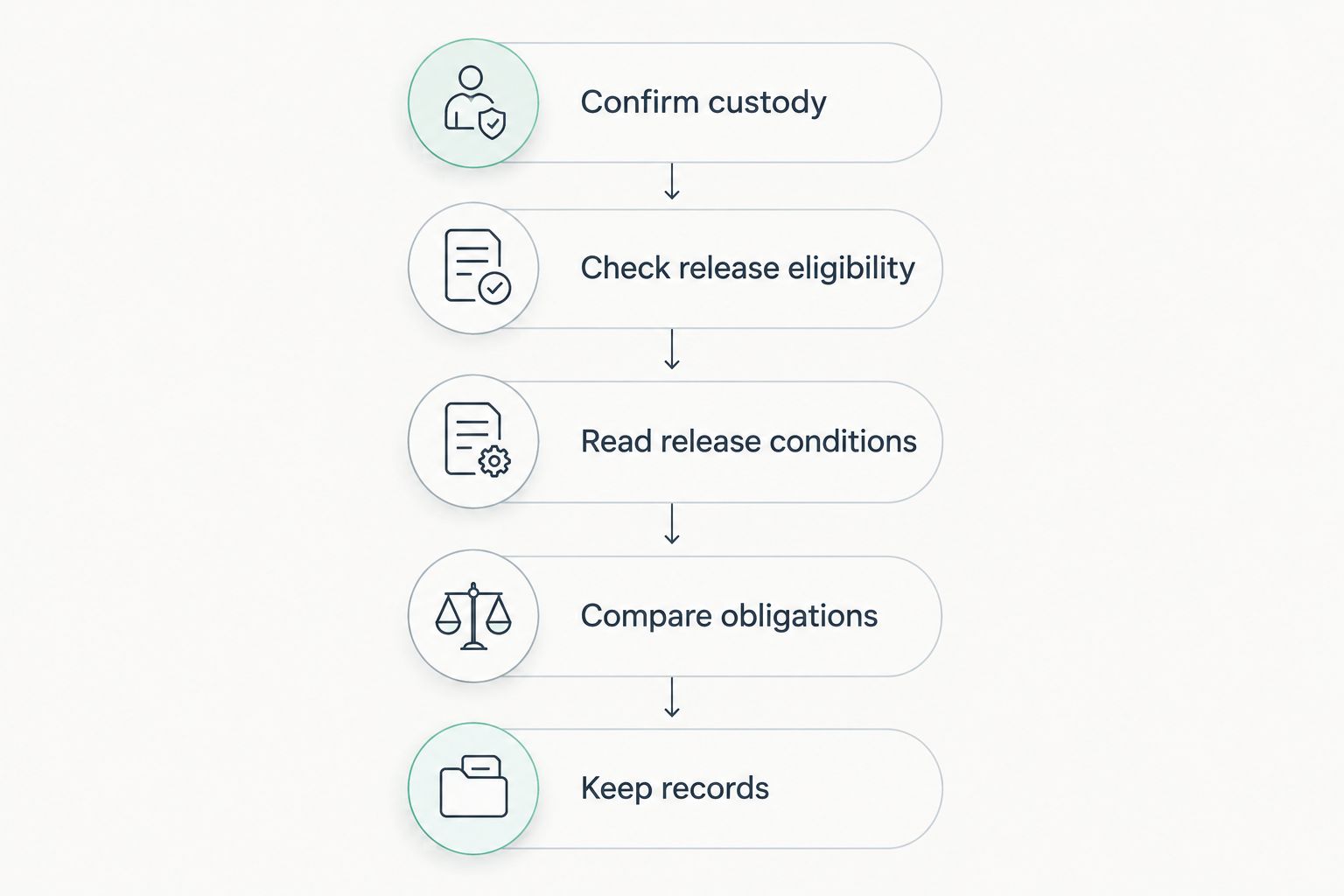
Use this sequence to narrow the options before signing or transferring funds:
- Confirm custody. Establish the person’s legal name, booking details, and actual holding facility through an official channel.
- Check release eligibility. Ask whether bail is authorized and whether another hold prevents release.
- Read release conditions. Have counsel explain any protective order or other restriction that affects what happens after release.
- Compare obligations. Review deposits, contractual liability, collateral exposure, and the requirements for ending each obligation.
- Keep records. Retain agreements, receipts, release paperwork, and the next court date together.
A 2026 decision should follow the current custody record and court order, not an older message from someone involved in the case. Recheck unclear information before you act.
Keep the conversations separate. The jail confirms custody information, the court controls release orders, the defense attorney advises on legal options, and the bond agent explains the commercial agreement. An answer from one does not replace the authority of another.
How the options are ranked
This 2026 ranking prioritizes release eligibility, contractual clarity, household exposure, and practical access. The licensed service ranks first for families seeking an agent after bail is authorized; own-recognizance release ranks first when the court approves release without posting bail.
Cash bail and property bonds serve narrower financial situations. Neither is automatically better because it avoids a commercial bond agreement. The correct comparison includes what your household places at risk and what the court will accept.
Which bail option should you choose?
Start with the court’s release order. If own-recognizance release is approved, follow that route without purchasing an unnecessary bond. If bail is authorized and you need an agent, consider the licensed service above after reviewing the agreement.
Choose cash bail only when the direct deposit fits your household finances. Consider a property bond only after confirming court requirements and receiving advice about the owner’s exposure. If release is not authorized, ask defense counsel about the legal next step rather than shopping for a different payment arrangement.
Review your bail bond options
Ask about licensed, around-the-clock assistance across California and the obligations in a bond agreement.
FAQ
What are the best bail bond options for assault charges?
The best option depends on the court’s release order: own-recognizance release if approved, or an accepted surety bond, cash deposit, or property bond when bail is authorized. Compare legal eligibility and financial obligations before committing.
Can a bail bondsman guarantee release after an assault arrest?
No bail bondsman can override a court order or a separate custody hold. A bond addresses an authorized bail requirement, not every reason a person remains detained.
Is cash bail better than using a bail bond agent?
Cash bail fits families that can deposit the required funds directly and manage those funds being unavailable. A surety bond uses a different arrangement with a private agent and creates contractual obligations, including a generally nonrefundable premium.
Can someone charged with assault get own-recognizance release?
Own-recognizance release depends on applicable law and the court’s decision in the specific case. Defense counsel can address eligibility, safety concerns, and proposed conditions; the charge label alone does not determine the answer.
Does paying bail cancel a protective order?
Paying bail does not cancel a protective order. The defendant must follow the order unless the court changes it, even if the protected person requests contact.
What should I ask before cosigning an assault bail bond?
Ask what you owe, what triggers additional liability, whether collateral is required, and what ends your obligations. Read the bond, financing, and collateral agreements separately before signing.
Can I use my house instead of cash for bail?
A court-approved property bond can use qualifying real estate as security, but approval is not automatic. Confirm the court’s requirements and get legal advice about ownership, existing liens, and forfeiture risk before proceeding.
One last thing
A cosigner’s responsibility and a defendant’s release conditions are separate obligations. Helping someone leave jail does not give you control over their future choices, and a clear payment arrangement does not remove the risk created by a missed appearance.
Before you sign, ask yourself whether you understand the agreement even if the case takes longer than expected or the defendant stops cooperating. Keep the answer grounded in the written terms. This guide provides general California information, not legal advice for a specific case.